
DOL issues proposed investment selection rule


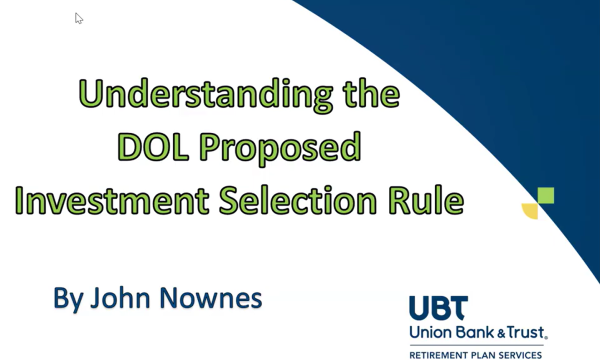
In March, the Department of Labor (DOL) issued a proposed “Fiduciary Duties in Selecting Designated Investment Alternatives” rule. So what does that mean for retirement plan sponsors? Read on as we discuss the presidential executive order that prompted the rule, the purpose and structure of the rule, our observations, and a recommendation that employers take a “wait and see” approach before considering whether to add alternative assets to its investment menu.
Presidential executive order
On August 7, 2025, the President issued an executive order titled “Democratizing Access to Alternative Assets for 401(k) Investors.” The primary purposes of the order were to allow workers to have greater access to alternative assets, such as private securities, in their 401(k) plans, and to alleviate the litigation risk that, in the administration’s view, has had a chilling effect on plan fiduciaries from offering alternative assets in 401(k) plans.
DOL’s goals in issuing proposed rule
At the President’s direction, the DOL issued the proposed rule which, when finalized, will apply to 401(k) and ERISA 403(b) plans. The DOL’s goal was to alleviate regulatory burdens and litigation risk, thus allowing participants to achieve greater returns and asset diversification.
The proposed rule affirms that ERISA is a process-based law and not an outcome-based law. Accordingly, a plan fiduciary should be evaluated based on the process used to select a plan’s designated investment alternatives, or DIAs. The DOL also wants fiduciaries to be confident — when they use a prudent decision-making process to select a plan’s DIAs — that they have fulfilled their fiduciary duty of prudence.
DOL’s 6-factor “Safe Harbor” rule
The DOL’s proposed safe harbor framework sets forth the following six non-exclusive factors a fiduciary should consider when selecting a plan’s DIAs:
- Performance. A fiduciary should consider an investment’s risk-adjusted returns net of expenses over an appropriate time horizon.
- Fees and expenses. A fiduciary should evaluate similar investment alternatives and determine that a DIA’s expenses are appropriate in light of its expected risk-adjusted returns.
- Liquidity. A fiduciary should ensure the DIA has sufficient liquidity to meet the needs of the plan and its participants.
- Valuation. A fiduciary must determine the DIA can be timely and accurately valued.
- Benchmarking. A fiduciary must compare each DIA’s risk-adjusted returns to a meaningful benchmark.
- Complexity. A fiduciary must assess an investment’s complexity before selecting it as a DIA.
The DOL expects fiduciaries to objectively, thoroughly, and analytically consider all relevant factors when selecting a DIA. The DOL believes that when following this prudent decision-making process, a fiduciary “should be able to confidently rely on that [decision] without undue fear of litigation.”
Our observations about the proposed rule
We’ve put together some of our thoughts after reviewing the proposed rule within the context of the executive order:
- DOL takes an asset-neutral approach. Although the President’s order focused on alternative assets, the DOL rule takes an asset-neutral approach. That is, a fiduciary’s analysis and decision-making process will be the same regardless of the type of investment being evaluated as a DIA.
- The proposed rule does not require alternative assets. In our estimation, the proposed rule does not require a fiduciary to evaluate or consider adding alternative assets to its plan. Accordingly, it’s appropriate for a plan’s DIA investment menu to consist solely of publicly traded mutual funds.
- DOL attempts to formalize fiduciary duty of prudence. In practice, the proposed rule does not make any significant changes to the ERISA decision-making landscape. Fiduciaries have always been required to satisfy the exclusive purpose, prudent purpose, and diversification rules when selecting DIAs. In essence, the proposed rule memorializes/formalizes the duty of prudence as applied to selecting DIAs.
- The proposed rule is not a true safe harbor. Instead, when evaluating the relevant factors in selecting DIAs, a fiduciary should be presumed to have engaged in a prudent decision-making process. It remains to be seen, however, whether the final rule will reduce frivolous lawsuits, and/or whether courts will give significant deference to a fiduciary’s judgement when complying with the rule.
- Fiduciaries should consider hiring outside experts. Throughout the rule and its examples, the DOL strongly suggests fiduciaries hire outside professionals — such as UBT — to help select DIAs. For example, a fiduciary can hire an ERISA 3(21) investment advisor who makes DIA recommendations while the responsible fiduciary (e.g., the plan sponsor) retains the final fiduciary decision to accept or reject the investment advisor’s recommendations. Alternatively, the fiduciary can delegate its fiduciary duty to an ERISA 3(38) investment manager who would become responsible and liable for selecting a plan’s DIAs.
What’s next?
The DOL is reviewing the nearly 45,000 comments submitted on the proposed rule and will then draft a final rule and submit it to the Office of Management and Budget for review. Industry insiders are suggesting a final rule may be issued in Q4 of 2026.
As always, the team at UBT will review the final rule and notify our clients about its substance. Additionally, we will review our practices and revise investment policy statements to incorporate the final rule’s provisions.
Finally, if you are thinking about adding alternative assets to your 401(k)/403(b) plan, we recommend taking a “wait and see” approach. Before making any decisions, it’s important that you understand the final rule, as well as how the marketplace will introduce alternative assets into retirement plans.
If you have any questions about the proposed rule or about UBT’s 3(21) or 3(38) fiduciary investment services, please contact your Union Bank relationship manager.


|
Learning Center articles, guides, blogs, podcasts, and videos are for informational purposes only and are not an advertisement for a product or service. The accuracy and completeness is not guaranteed and does not constitute legal or tax advice. Please consult with your own tax, legal, and financial advisors.
