
Market Recap: April 2026

May 06, 2026

Market commentary
- Supply disruptions near the Strait of Hormuz have pushed oil and gas prices higher, lifting headline inflation and increasing costs for consumers and businesses.
- With core inflation still above 3% — well over the Fed’s 2% target — energy costs are keeping policymakers cautious.
- Consumer spending is holding up, led by higher-income households benefiting from wealth gains, while lower-income consumers face more strain and rely on work, savings, or credit.
- Housing continues to weigh on growth, as high interest rates and affordability constraints suppress homebuilding, permits, and completions.
Select economic and market data
Statistic (monthly unless noted) |
Current |
Previous |
|---|---|---|
| U.S. GDP (quarterly) | 2.0% | 0.5% |
| Consumer Confidence | 92.8 | 92.2 |
| Consumer Price Index Y/Y | 3.3% | 2.4% |
| Core PCE (x food & energy) | 3.2% | 3.0% |
| ISM Manufacturing Index | 52.7 | 52.7 |
| Unemployment Rate | 4.3% | 4.4% |
| 2-Year Treasury Yield | 3.87% | 3.80% |
| 10-Year Treasury Yield | 4.37% | 4.32% |
Equities
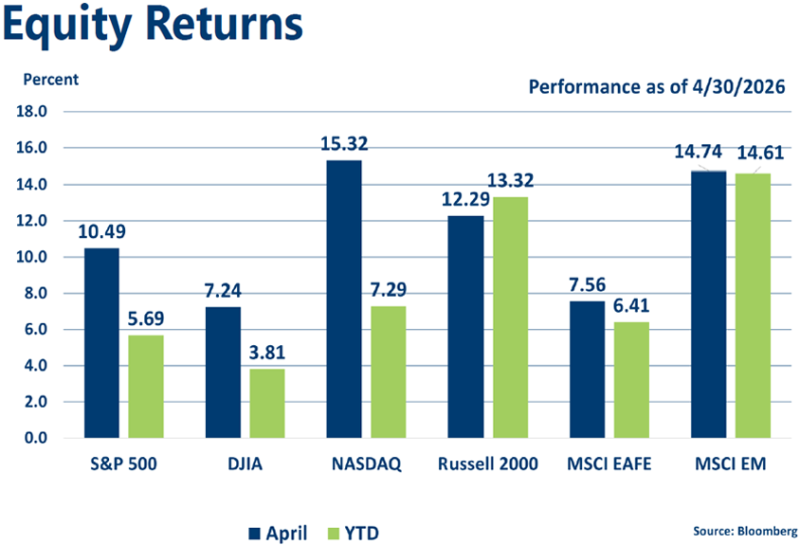
- Stocks surged in April, with the S&P 500 posting double-digit gains despite concerns over the potential economic fallout from a global energy shock.
- Driven by AI-focused mega-cap tech stocks, first-quarter S&P 500 earnings grew 27.1% year over year — the strongest pace since Q4 2021.
Fixed income
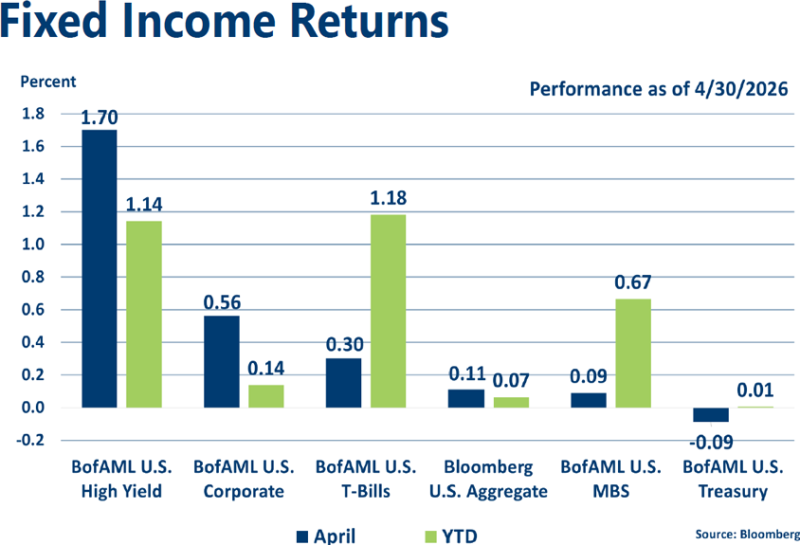
- With Fed policy unchanged, bond yields moved within a narrow range, with the 10-year U.S. Treasury yield ending April at 4.37%, up slightly from 4.32% the prior month.
- In line with equity strength, high-yield bonds — and to a lesser extent, corporate bonds — led fixed-income returns in April.
Strategic outlook
- Near-term caution toward equities is advisable, given heightened risks from geopolitical instability, trade uncertainty, and the potential for renewed inflationary pressures alongside an economic slowdown.
- Near-average expected returns projected for fixed income with the Fed on pause and rates reflective of economic conditions.
- Above-average volatility is likely given central bank involvement and geopolitical uncertainty.

|
Learning Center articles, guides, blogs, podcasts, and videos are for informational purposes only and are not an advertisement for a product or service. The accuracy and completeness is not guaranteed and does not constitute legal or tax advice. Please consult with your own tax, legal, and financial advisors.
