
Market Recap: July 2026

August 04, 2026

Market commentary
- Second-quarter GDP rose a modest 1.5%, yet rising prices pushed the total value of the economy up nearly 8%, underscoring that inflation did much of the heavy lifting.
- Although household sentiment weakened again in July, actual spending held up as consumers have benefited from rising asset values.
- Employers added a slower 57,000 jobs for the month, though the unemployment rate edged down to 4.2%, its lowest in a year.
- Continued tensions between the U.S. and Iran pushed oil back above $90 a barrel, reviving a key risk that feeds through to gas prices and the broader cost of living.
- Mortgage rates stayed stubbornly high and homebuilding activity kept slipping, leaving the housing sector effectively frozen.
Select economic and market data
Statistic (monthly unless noted) |
Current |
Previous |
|---|---|---|
| U.S. GDP (quarterly) | 1.5% | 2.1% |
| Consumer Confidence | 90.8 | 92.2 |
| Consumer Price Index Y/Y | 3.5% | 4.2% |
| Core PCE (x food & energy) | 3.3% | 3.4% |
| ISM Manufacturing Index | 55.6 | 53.3 |
| Unemployment Rate | 4.2% | 4.3% |
| 2-Year Treasury Yield | 4.29% | 4.18% |
| 10-Year Treasury Yield | 4.74% | 4.47% |
Equities
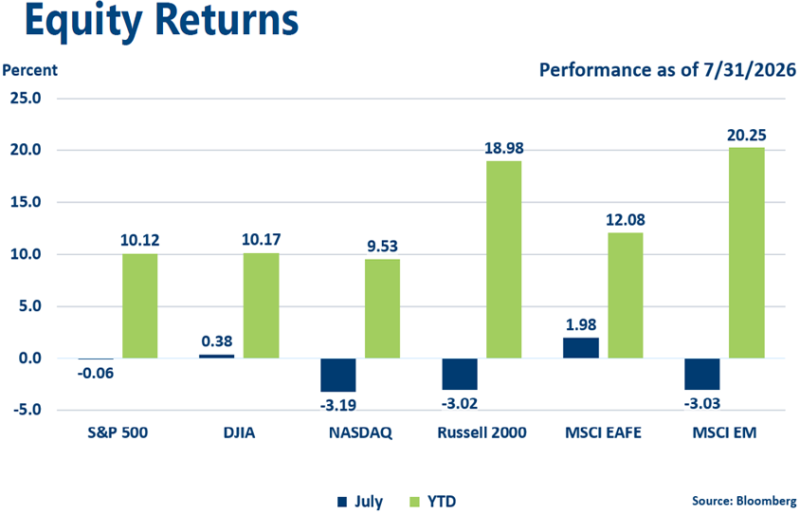
- Despite elevated volatility beneath the surface, strong earnings growth, renewed leadership from energy stocks, and continued year-to-date outperformance by small caps and emerging markets highlighted market strength and investors' ongoing willingness to embrace risk.
Fixed income
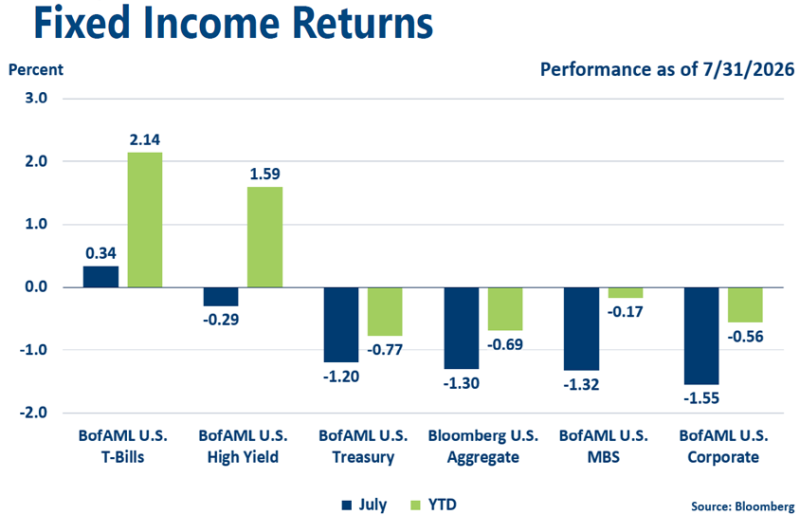
- Bond prices fell in July as investors raised expectations for additional Fed rate hikes, driving long-term Treasury yields to their highest levels since 2007 and increasing concerns over defaults among lower-rated corporate borrowers.
Strategic outlook
- Near-term caution toward equities is advisable, given heightened risks from geopolitical instability, trade uncertainty, and the potential for renewed inflationary pressures alongside an economic slowdown.
- Near-average expected returns projected for fixed income with the Fed on pause and rates reflective of economic conditions.
- Above-average volatility is likely given central bank involvement and geopolitical uncertainty.
|
Learning Center articles, guides, blogs, podcasts, and videos are for informational purposes only and are not an advertisement for a product or service. The accuracy and completeness is not guaranteed and does not constitute legal or tax advice. Please consult with your own tax, legal, and financial advisors.
